
Winamax poker formats and automation
The incidence of automation on a given poker format is determined in part by its speed and structural repetition. Faster, more repetitive formats are more attractive to automated playing agents and at the same time produce more behavioural data for the operator's detection system. Winamax's Expresso format is the principal example of both properties.
Winamax built its identity on Expresso, a three-handed hyper-turbo sit-and-go with a randomised, lottery-style prize multiplier. Short stacks, three players and a near-solved preflop game make it tempting for automation — but those same traits make a human’s play noisy and a bot’s play conspicuously regular.
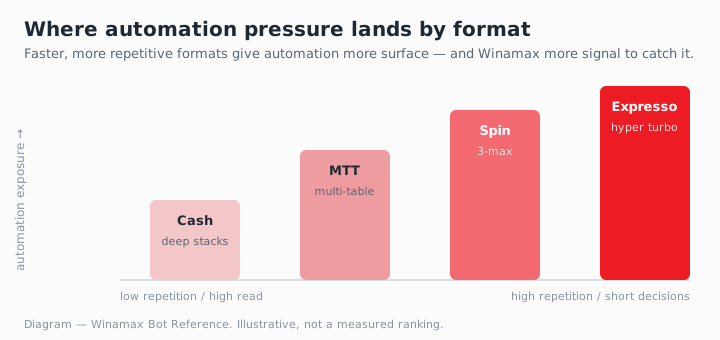
Format by format
Expresso — hyper-turbo 3-max
Short decision trees and huge volume are exactly what automation wants. They are also what detection wants: thousands of near-identical spots make a bot’s timing and sizing fingerprint impossible to hide. High exposure, but also the highest signal density for the platform.
Spin formats — fast 3-handed
Same family as Expresso: quick, repetitive, short-stacked. Strong automation pull, and the rapid hand cadence means a behavioural baseline forms quickly.
MTT — multi-table tournaments
Longer, more varied, with shifting stack depths and ICM pressure. Harder to fully automate well, but mass multi-tabling and uniform timing across very different spots still flag.
Cash — deep stacks
Deep stacks and a high read on opponents make cash the hardest to automate convincingly — and it is where a real-time assistant, not a full bot, is the more common (and equally banned) shortcut.
Reference points
| Format | Players | Pace | Automation pull |
|---|---|---|---|
| Expresso | 3 | Hyper-turbo | Very high |
| Spin | 3 | Turbo | High |
| MTT | Many | Variable | Medium |
| Cash | 2–6 | Steady | Lower (RTA risk instead) |
Across every format the conclusion is the same: automation is against the rules and is caught. The format only changes how fast.

A question about account security?
We document how bots and detection actually work. For a specific question on compliance or account safety, reach the team.